Boiler-related failures are the single largest cause of unplanned downtime at waste-to-energy plants. In its August 2022 analysis of outage data, POWER Magazine reported that waste-to-energy and biomass plants averaged 22.9 days of unplanned downtime in 2021, with 43% of that attributable to the boiler and 9.9 days lost to boiler failures alone. Boiler fouling waste-to-energy operators live with day to day, and the superheater corrosion that follows it, are not incidental maintenance items. They are the largest single line on the downtime ledger, and much of the burden traces back to what is actually arriving at the grate, hour by hour, and how variable it is.
The mechanism: boiler fouling waste-to-energy plants see from chlorine-rich, variable feedstock
Municipal solid waste carries chlorine from PVC, food-contaminated packaging, and ordinary kitchen salt, alongside alkali metals (potassium, sodium) and heavy metals (lead, zinc) from food waste and mixed residuals. None of this is exotic; it is normal household and commercial waste composition. The problem is what these elements do together once they reach flue gas temperature.
HCl and molten-salt deposit formation on superheater tubes
During combustion, chlorine converts largely to HCl in the flue gas. In the presence of alkali metals, it also forms alkali chlorides (KCl, NaCl) that vaporise in the furnace and then condense as flue gas cools across the superheater bank. These chlorides, together with sulfates and heavy-metal compounds, form low-melting eutectic mixtures on tube surfaces. Deposit chemistry consistent with this mechanism, including molten-salt-driven high-temperature attack on superheater tubes in an operating waste-to-energy plant, is documented in Corrosion Science (2011). The molten or semi-molten salt layer fluxes away the protective chromium-oxide scale that would otherwise shield the tube metal, exposing bare alloy to renewed attack. Where chlorine reaches the metal surface through cracks in the deposit, an active-oxidation cycle can take hold: chlorine forms volatile metal chlorides at the metal-oxide interface, these migrate outward and oxidize, releasing chlorine again to continue the attack. A closely related mechanism, studied in biomass boilers rather than waste-to-energy units, is described in ORNL/TM-2011/399 - it is not waste-to-energy evidence, but the underlying chlorine and alkali chemistry is directly relevant, since biomass co-firing shares the same corrosion-driving elements.
Why fouling and corrosion compound each other over an operating cycle
Fouling and corrosion are not two separate problems running in parallel; they drive each other. The initial sticky salt layer on a superheater tube captures fly ash, and the deposit thickens. A thicker, insulating deposit reduces heat transfer at that point in the bank, pushing flue gas and tube metal temperature higher downstream to compensate. Higher tube metal temperature accelerates the molten-salt corrosion chemistry underneath the deposit. So the fouling that starts as a heat-transfer nuisance becomes, over weeks, the condition that sustains a hotter and more corrosive surface than the tube would otherwise see. This is why deposits are removed on a cleaning schedule, not as an afterthought: left alone, a deposit does not just accumulate, it changes the corrosion regime underneath it.
How feedstock variability specifically makes this worse
Wide swings in calorific value force wider combustion control excursions
None of the chemistry above requires variable feedstock to occur. What variability does is widen the operating envelope the boiler has to be controlled across. When calorific value swings between deliveries, or within a single delivery as it is fed to the grate, combustion control has to react: adjusting grate speed, primary and secondary air ratios, and auxiliary burner output (support firing) to hold furnace temperature and steam parameters within design limits. Wider, faster swings mean more frequent, more aggressive control action, and more excursions into combustion conditions - locally fuel-rich or fuel-lean, locally cooler or hotter - outside the narrow band the boiler and its metallurgy were designed around.
Why a stable calorific value band is a corrosion mitigation lever, not only a throughput lever
Calorific value stability is usually discussed as a throughput and permit-compliance question. It is also, less often stated, a corrosion-adjacent variable. Combustion instability is a documented contributor to the fouling and corrosion mechanisms above: it drives local temperature excursions in the furnace and superheater section, and it correlates with periods where chlorine and alkali loading in the flue gas are also swinging, since the same heterogeneous deliveries that swing calorific value often carry uneven chlorine content (PVC-heavy loads, salt-contaminated fractions) at the same time. Tightening the calorific value band does not remove chlorine from the fuel and will not by itself stop corrosion. What it does is reduce how often the boiler is forced away from its designed operating point to compensate for feed swings, and reduce the manual interventions operators need to hold steady combustion through a shift. That is a more modest claim than a fouling or corrosion reduction figure, and the honest one: no dated, sector-specific figure exists yet for how much a tighter calorific value band reduces fouling or corrosion rates, and any number offered without a named source should be treated with suspicion.
What reduces feedstock variability at the point waste enters the process
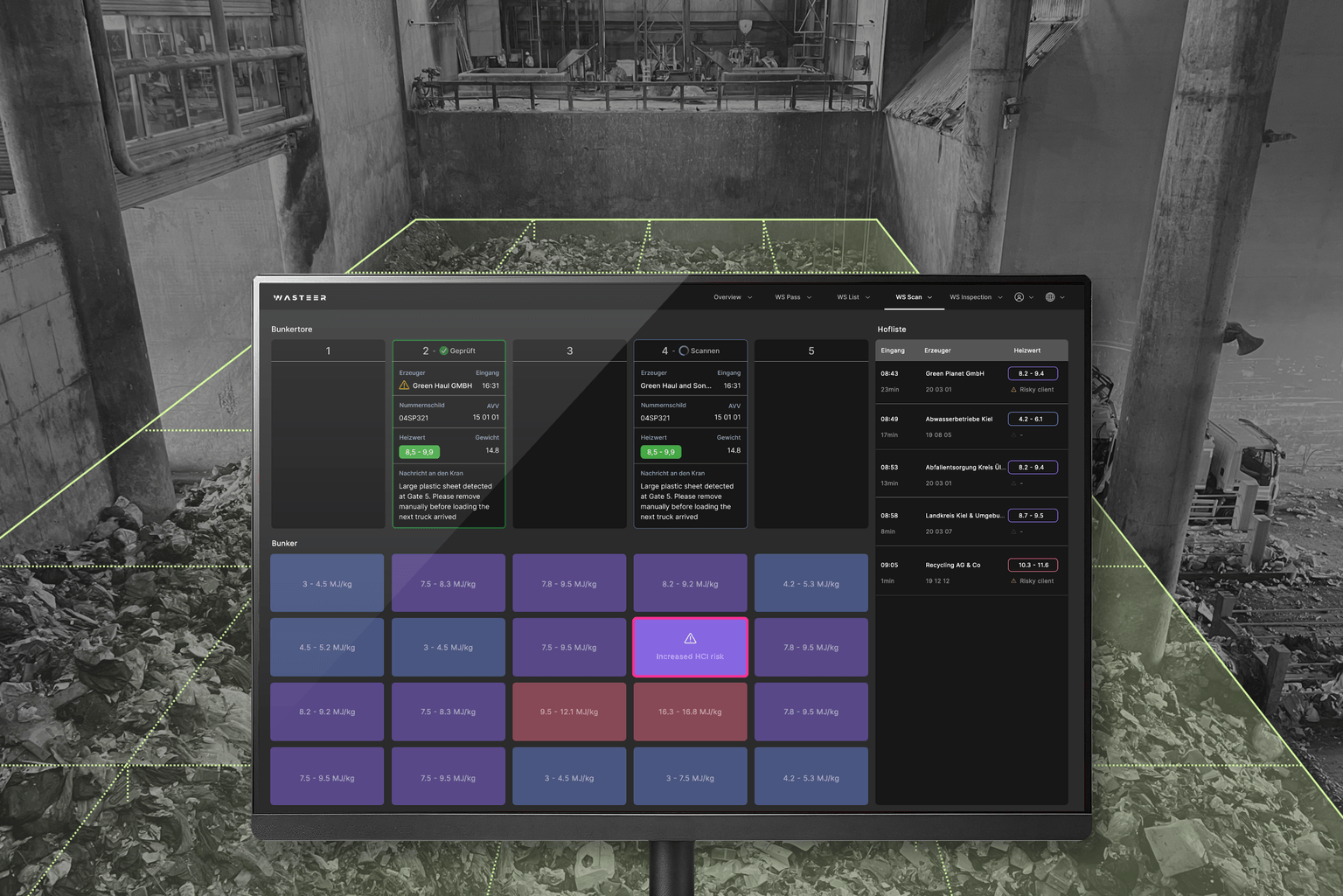
The lever available before waste reaches the grate is intake control: knowing the composition and calorific value of what is arriving, delivery by delivery, well enough to sequence and blend it before charging. Wasteer's platform is already in use in more than 20 plants doing exactly this - blending deliveries by measured composition to smooth what reaches the boiler, via continuous calorific value measurement at the tipping point rather than periodic manual sampling. The same intake visibility catches safety-critical contaminants that independently disrupt combustion stability, from gas cylinders to battery ignition events, and produces the delivery-level record that regulatory monitoring regimes increasingly expect - see also how data-driven intake control fits the broader picture. None of this replaces maintenance planning, inspection regimes, or metallurgy decisions. It addresses one upstream contributor to combustion instability, itself one documented contributor among several to fouling and corrosion.
What to check: is your fouling and corrosion problem a feedstock problem or a materials problem
Before attributing a fouling or corrosion trend to feedstock, check the evidence that distinguishes the two. Pull deposit samples from the affected tube bank and analyse alkali chloride versus sulfate ratio: a chloride-dominant deposit points toward active chlorine attack, which feedstock control can influence; a sulfate-dominant or unusual deposit chemistry may point toward a specific fuel fraction or a metallurgy mismatch instead. Correlate your combustion control log (air ratios, auxiliary burner duty cycles, temperature excursions) against delivery-level calorific value records for the same period; a strong correlation between high-variability windows and control excursions supports a feedstock-driven read. Track wall-thickness trending by ultrasonic testing at the same tube locations over successive outages: a corrosion rate that holds steady regardless of feedstock mix or supplier changes points toward tube alloy, superheater staging, or steam temperature design as the dominant variable - cladding, alloy upgrade, or re-staging is then the more direct fix than intake control. Most plants find both factors present in some proportion; the diagnostic value is in knowing which one to spend capital on first.
FAQ
Does stabilising calorific value at intake eliminate the need for superheater cladding or metallurgy upgrades? No. Intake stabilisation addresses combustion instability as one upstream contributor. It does not remove chlorine from the fuel, does not change tube alloy chemistry, and does not substitute for inspection, cleaning schedules, or metallurgy decisions where deposit and wall-thickness data show those are the dominant factor.
Is HCl and alkali-chloride corrosion a waste-to-energy-specific mechanism, or does it show up elsewhere? The core chemistry, chlorine and alkali metals forming corrosive low-melting deposits on superheater tubes, is documented directly in waste-to-energy operation in the Corrosion Science 2011 study cited above. A closely related mechanism is documented in biomass boilers (ORNL/TM-2011/399); that is biomass evidence, not waste-to-energy evidence, cited here only as an adjacent-sector reference for the shared chlorine and alkali chemistry.
Can continuous intake monitoring reduce soot-blower or mechanical cleaning frequency? There is a plausible mechanistic path - fewer combustion excursions should mean less aggressive local fouling - but no dated, sector-specific figure exists yet quantifying that effect, and this article does not offer one. Track your own cleaning frequency against your own intake variability data before assuming a reduction.
Where does 17. BImSchV fit into this? The amended 17. BImSchV (February 2024) sets air emission limits for incineration and co-incineration of waste in Germany; it governs what leaves the stack, not the fouling and corrosion mechanism inside the boiler. It is relevant background for German operators but is not the regulatory driver for the mechanism described here.