Lithium-ion battery fires at waste facilities are climbing faster than most operators' incident logs show, and the trend line is not levelling off. A big part of the shift is upstream: disposable vapes and single-use e-cigarettes, each built around a small lithium cell moulded permanently into the plastic housing, now go into general waste bins by the million because there is no practical way for a consumer to remove the battery before disposal. Add end-of-life power tools, e-bike batteries, laptops and loose button cells from toys and remote controls, and the waste stream is carrying more energy-dense, damage-prone cells than ever before. None of these items are designed to survive a bale press, a shredder blade or a crane grab. When they don't, the failure mode is thermal runaway: a short circuit inside a damaged or crushed cell releases stored energy as heat faster than it can dissipate, feeding on itself until the cell vents, ignites or explodes. For plant operators, safety and compliance managers, the question isn't whether battery fire prevention belongs on the waste-to-energy risk register. It already does. The question is where in the process a battery gets caught before it reaches a compactor, a shredder or a bunker fire.
The scale of the problem: lithium-ion battery fires at waste facilities by region
United States and Canada. A study commissioned by NWRA and conducted by RRS, published January 2024, put the number at more than 5,000 fires a year at US recycling facilities attributable to lithium batteries, with catastrophic property loss up 41% over five years. Insurers have repriced the risk accordingly: premiums moved from under $0.20 to as much as $10 per $100 of coverage at affected facilities (Resource Recycling, January 2024). The trend is still rising, not plateauing: Fire Rover's 2024 tally, reported by Resource Recycling in March 2025, counted 430 facility fires across the US and Canada in 2024, up from 373 in 2023, a 15% increase, with fires at MRFs and transfer stations specifically up 20% (Resource Recycling, March 2025).
Germany. The German Insurance Association (GDV), citing figures from waste industry body BDE, put the number at roughly 30 battery fires a day across German waste and recycling operations, and named compaction specifically, not mere presence in the load, as the ignition trigger (GDV, April 2025). That daily figure builds on a longer-running problem: as early as 2019, risk assessor Dekra was already describing weekly lithium battery fires at German recycling facilities, with metal fires from damaged cells reaching 1,000 to 1,500 degrees Celsius, hot enough to compromise structural steel (sifa-sibe.de, July 2019).
United Kingdom. FCC Environment and the National Fire Chiefs Council reported more than 1,200 battery fires in refuse vehicles and waste facilities in 2023/24, up 71% year on year. The Environmental Services Association estimates that around 70% of recycling centre fires are battery-caused, at an industry cost of roughly £1bn a year (FCC Environment, April 2025).
Three countries, three trade associations, one direction of travel.
Why a battery is a different detection target from a gas cylinder
Wasteer already runs the same detection layer that already flags gas cylinders and nitrous oxide canisters at facilities across Europe, and it is tempting to treat batteries as just another item on that list. They are not, not entirely. A gas cylinder is a known, rigid, largely uniform shape: a cylinder is a cylinder, whether it is a nitrous oxide canister or a butane can, and the hazard is the pressure vessel itself. A battery pack has no single shape. It can be a laptop pack, a vape with a circuit board fused into a 40mm plastic tube, a power tool pack, a swollen phone battery, or loose 18650 cells rattling free in a bag, and the visual signature varies by brand, damage state and what the cell is wrapped in. The hazard mechanism differs too: a cylinder is dangerous because of what happens if its casing fails under heat or impact. A battery is dangerous because a short circuit inside a cell that still looks intact can start a runaway reaction with no external trigger at all. Detection has to be trained on that variability, not on one silhouette.
Detecting batteries before the crane grab, shredder or compactor
What the camera system flags and how
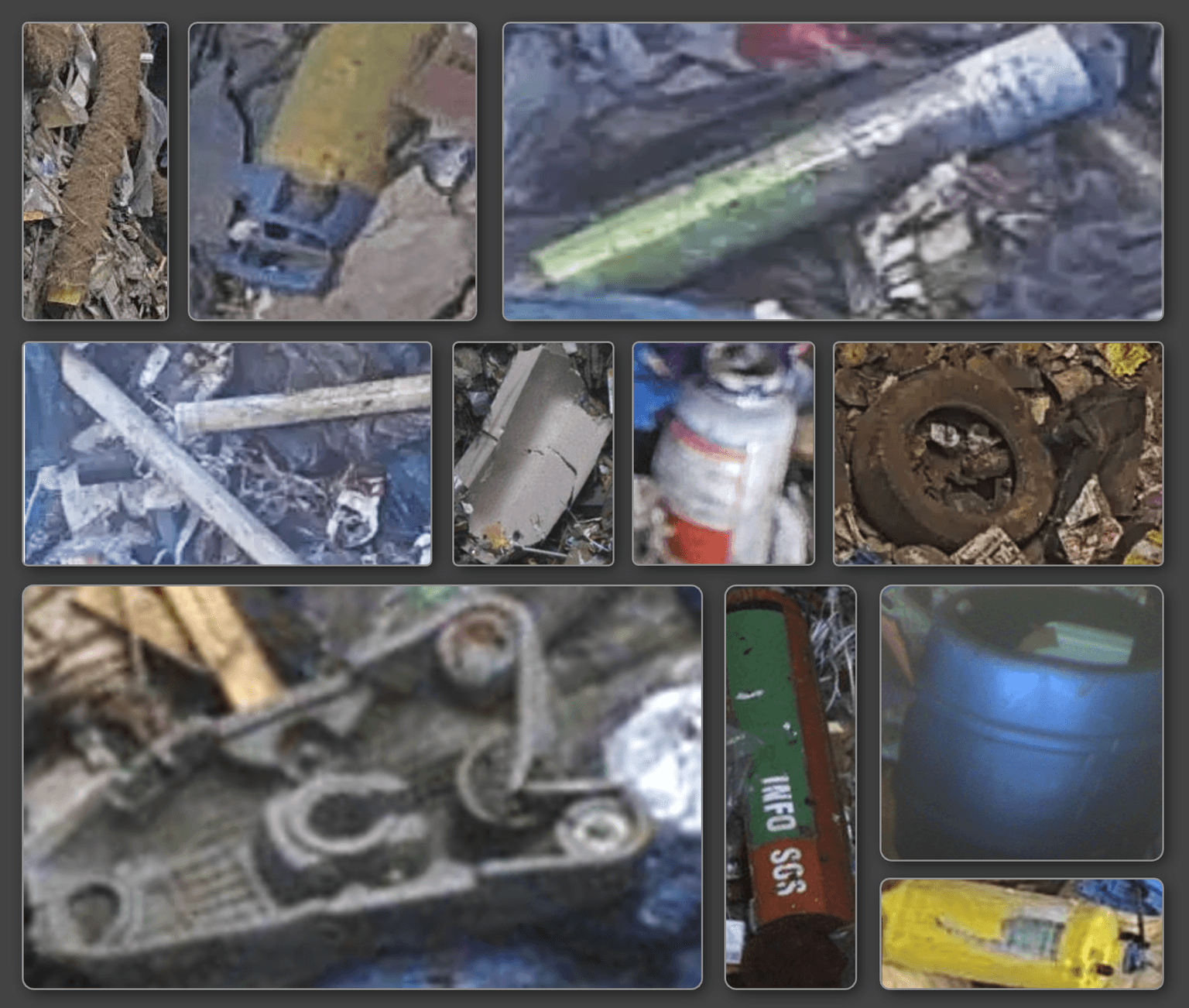
Cameras over the tipping area, the bunker or the conveyor feed run the same computer-vision pipeline behind Wasteer's existing contaminant detection, extended with battery-specific training data; see how contaminant detection fits the wider composition analysis system for the underlying architecture. The system recognises battery form factors across states: intact packs, loose cells, swollen or corroded casings, and devices with a battery visibly embedded, such as power tools, laptops, e-bike packs and vapes. When a probable battery is identified, flagged items are pulled before they reach the bunker or crane grab, giving staff a window to intervene ahead of mechanical stress. Wasteer's AI detection technology is already in use in more than 20 plants across Europe, and battery recognition runs on the same camera infrastructure already installed for gas cylinder and contaminant detection, not a separate system.
Why compaction is the ignition trigger, not merely presence
A battery sitting undisturbed in a load is comparatively low risk. The danger escalates sharply the moment mechanical force is applied: a crane grab crushing a pack, a shredder blade puncturing a cell, or a compactor ram compressing a load where a battery is buried. That is precisely the mechanism GDV's April 2025 guidance flags for German facilities: crush-in-compactor ignition, where the damage event and the resulting fire are separated only by the time it takes thermal runaway to propagate through the cell. Detection therefore has to happen at intake, before the waste stream reaches a crane grab, shredder or compactor, rather than relying on staff to notice smoke or smell after the fact.
Response protocol when a battery is flagged
Detection only reduces risk if the response behind it is rehearsed, not improvised. A minimum viable protocol:
- Alert routes to a named operations role, not a general channel, with camera location and a still image attached.
- Flagged material is isolated in a marked holding area, separate from the active feed, using the same quarantine-zone logic already applied to detected gas cylinders.
- A trained team removes the item without crushing or puncturing force, with gloves and, where the pack shows heat or swelling, a fire-rated container.
- Removal and its location in the load are logged, so patterns by supplier or waste stream become visible over time.
- If a cell is already venting or alight, the response defaults to the facility's existing thermal event procedure. Water is not always correct for lithium fires; staff should follow site-specific suppression guidance, not general instinct.
Facilities that already run a quarantine process for gas cylinders can extend the same zone and escalation path to batteries, rather than building a parallel workflow. That consistency is also what ties contaminant detection into the wider push from contaminant to resource across a plant's intake process.
What to check before buying a battery detection capability
Detection systems are being marketed faster than they are being independently verified, so a short due-diligence list before signing:
- What does the training data actually cover? Swollen, corroded or bagged cells hidden among other waste are the harder case, and the one that matters operationally.
- Does the alert reach a named role with enough context, camera, location, image, to act inside minutes, not a dashboard nobody watches?
- Can the vendor run battery detection on the same camera infrastructure already covering gas cylinders and other contaminant classes? Separate hardware doubles cost for no operational gain.
- How does the system perform on partially obscured items, wedged in a bag or buried under other waste, rather than a clean pack alone on a conveyor?
- Is there a reference site in a comparable facility type? A system tuned on sorting-line waste does not necessarily transfer to bunker conditions.
FAQ
Is every waste facility fire caused by a lithium battery? No, but battery involvement is now a leading contributor. FCC Environment cites Environmental Services Association estimates that around 70% of UK recycling centre fires are battery-caused, and US Fire Rover data shows total facility fires climbing alongside the growth in battery-containing waste.
Are disposable vapes really a meaningful part of this? Yes, increasingly. Disposable vapes carry a small lithium cell most consumers have no practical way to remove before disposal, so they enter general waste as intact, undamaged batteries waiting for a shredder or compactor to breach the casing.
Can existing metal detectors catch loose batteries? Not reliably. Metal detectors flag ferrous and some non-ferrous content generically. They do not distinguish a battery from any other metal object, and say nothing about its condition or damage state, which is what determines fire risk.
Does battery detection need a separate camera system from gas cylinder detection? No, and it should not. The same detection layer that already flags gas cylinders and nitrous oxide canisters is trained to also recognise battery packs and loose cells, running on the camera infrastructure already installed at intake. See the solutions overview for how it fits a facility's intake process.