Carbon capture at energy-from-waste plants has moved from studies to construction. Oslo's Klemetsrud plant has a final investment decision and a removals buyer, the UK's Protos facility is building a capture plant next to its new energy recovery facility, and the EU adopted its first certification rules for permanent carbon removals in 2026. What makes waste different from other capture projects is that roughly half of the CO2 in the flue gas is biogenic. Captured and stored, that half can count as carbon removed from the atmosphere. The other half is fossil and counts as avoided emissions. Which is which has to be proven.
Where the projects stand
Oslo, Norway. Hafslund Celsio's board made the final investment decision for carbon capture at the Klemetsrud waste-to-energy plant on 24 January 2025, with a budget of NOK 8.3 billion. The plant is designed to capture 90% of the CO2 in the flue gas, about 350,000 tonnes a year, stored permanently through the Northern Lights part of Norway's Longship project (HitecVision). In June 2025 Hafslund Celsio agreed to sell 1.1 million tonnes of permanent carbon removals to Microsoft over ten years (HitecVision). Frontier lists a delivery timeline of 2029 to 2030 for removals from the project (Frontier).
UK. Encyclis's Protos energy recovery facility reached first fire on residual waste in 2026, with construction of its carbon capture facility underway alongside (letsrecycle.com). Cory has announced plans to add carbon capture at its Belvedere site in London (letsrecycle.com). A Viridor-commissioned ERM report put the total capital investment for carbon capture across UK energy-from-waste at £19 billion (KnowESG), and enfinium became the first UK energy-from-waste business to join the CCS+ carbon-accounting initiative (gasworld).
EU rules. The European Commission adopted the first methodologies for certifying permanent carbon removals under the Carbon Removals and Carbon Farming Regulation in February 2026, covering direct air capture, bioenergy with carbon capture and storage (BioCCS) and biochar (European Commission). How mixed waste feedstocks with both biogenic and fossil carbon are treated is set out in the methodology annexes, which operators should check directly.
Why waste is different
A cement kiln or a gas power plant burns fossil carbon, so captured CO2 is avoided emissions. A biomass plant burns biogenic carbon, so captured CO2 is removal. A waste-to-energy plant does both at once, in a ratio that changes with every truck.
Studies put the biogenic share of waste incineration CO2 at roughly half: 55 to 64% at three Austrian plants in a 2026 comparison of measurement methods (Fellner et al. 2026), and an average fossil carbon share of 48 ± 4% in Switzerland (Empa). At the Klemetsrud design capacity of 350,000 tonnes a year, every percentage point of biogenic share is 3,500 tonnes of CO2 that either counts as a removal or does not.
That split drives two revenue lines. The biogenic share is what can be sold as removals, as in the Microsoft agreement. The fossil share is what a plant would otherwise pay for under a carbon price, such as the EU ETS from 2031 or Germany's BEHG. Both depend on the same measured number.
The economics are not settled
Capture costs energy. A 2026 study from Brunel University found that an 80% capture rate imposes an energy penalty of 35% on an energy-from-waste plant with carbon capture, and that a UK carbon price of £49.4 per tonne of CO2 is not enough on its own to incentivise deployment (Brunel University). Removal revenues from buyers such as Microsoft, and policy support for greenhouse gas removals, are what close that gap. Both pay for proven biogenic tonnes, not for an assumed average.
The certification rules themselves are contested: a coalition of environmental groups has challenged the EU's permanent removals methodologies (ENDS Waste & Bioenergy). Either way, removal claims from waste will be scrutinised closely.
Proving the biogenic share
The reference measurement is carbon-14 in the captured or emitted CO2, standardised in ISO 13833, and the balance method under ISO 18466 can run continuously from plant data. We compare both in fossil vs biogenic CO2: how to measure it. Private registries building on the EU methodologies also require a defined method for the biogenic fraction when a feedstock contains inseparable biogenic and fossil carbon (Isometric).
What these measurements give is the share for a period. What they do not give is the reason it moved. For a capture plant selling removals, a falling biogenic share is lost revenue, and the operator needs to know which waste streams caused it.
Where delivery-level composition data helps
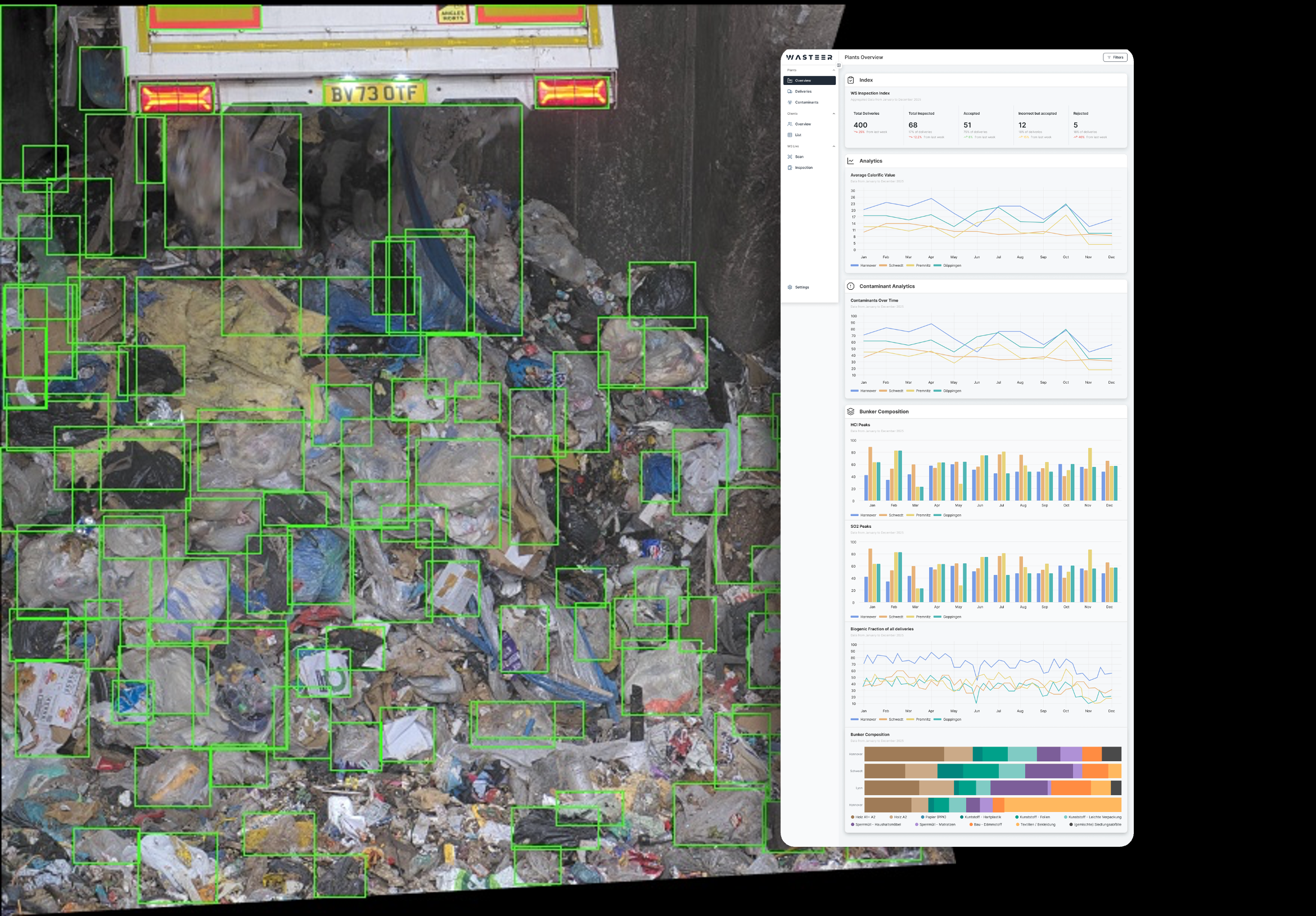
WS Scan captures every delivery with cameras as it is tipped and estimates its composition and key figures such as calorific value and biogenic share, linked to the delivering vehicle. WS Track follows where that waste goes in the bunker and when it is fed. For a capture project, that gives three things the stack measurement cannot:
- An early signal. A shift towards plastic-rich deliveries shows up at the gate before it shows up in a monthly carbon-14 result.
- An explanation. Variance in the biogenic share can be traced to suppliers, contracts and seasons, which is what a verifier or a removals buyer will ask about.
- A lever. Feed planning and supplier agreements can be managed with the biogenic share in mind, not only the calorific value.
This does not replace a recognised measurement method or third-party verification. It is the operational data around them.
FAQ
Does carbon capture at an EfW plant create negative emissions? Only for the biogenic share of the captured CO2. The fossil share is avoided emissions. With roughly half of waste carbon biogenic, a capture plant produces both.
Which EfW carbon capture projects are furthest along? Hafslund Celsio's Klemetsrud project in Oslo has a final investment decision from January 2025 and a ten-year removals agreement with Microsoft. In the UK, Protos is building a capture facility next to its new energy recovery facility.
How is the biogenic share of captured CO2 measured? Typically by carbon-14 analysis under ISO 13833, sometimes complemented by the balance method under ISO 18466. The method required depends on the scheme or certification standard.
Is carbon capture at waste plants economic? Not on carbon prices alone, according to a 2026 Brunel University study that found a 35% energy penalty at 80% capture. Removal revenues and policy support are expected to close the gap.