Every carbon price that applies to waste incineration, or is about to, charges only the fossil share of the CO2. Germany's national CO2 price, the UK's monitoring period, France's measurement obligation and the EU ETS proposal for 2031 all turn on the same number: how much of the carbon a plant burns came from plastics and other fossil materials, and how much from paper, wood, textiles of natural fibre and food waste. Roughly half of it is usually biogenic, so the way that share is determined decides a large part of the bill.
This article compares the established methods, what each one actually measures, and where they disagree. It is general information, not a compliance guide; the method a plant may use is set by its scheme and its competent authority.
Why the split matters
Mixed municipal waste is roughly half biogenic. A long-term study by the Swiss research institute Empa found an average fossil carbon share of 48 ± 4% for waste incineration in Switzerland, with plant-to-plant differences that tracked waste composition (Empa). A 2026 study of three Austrian plants and one Chinese plant found biogenic CO2 shares of 55 to 64% in Austria and 53 to 63% in China, with fossil emission factors of 320 to 470 kg CO2 per tonne of waste in Austria (Fellner et al., Waste Management 2026).
Those ranges are wide. At a plant burning 300,000 tonnes a year, the difference between a 320 kg and a 470 kg fossil emission factor is 45,000 tonnes of CO2. At any carbon price, that is the difference between two very different budgets, and it comes almost entirely from what is in the waste.
The four established methods
Manual sorting analysis
Samples of the incoming waste are sorted by hand into fractions (paper, plastics, textiles, organics, inerts and so on), and each fraction is assigned a typical biogenic and fossil carbon content. It is intuitive and shows which materials drive the fossil share. Its weakness is representativeness: a sorting campaign covers a few tonnes out of tens of thousands, on a few days, and composition changes by supplier and season. It is one of the standardised methods listed in TU Wien's research on biomass content determination (TU Wien).
Selective dissolution
A laboratory method in which biogenic material is dissolved chemically and the remaining fossil fraction is weighed. It works on prepared samples, so it shares the sampling problem of sorting analysis: the result is only as representative as the few kilograms that reach the lab.
Carbon-14 in the flue gas
Biogenic carbon contains the radioactive isotope carbon-14 at present-day atmospheric levels; fossil carbon contains none. Measuring the carbon-14 content of the CO2 in the stack gives the biogenic share of what was actually burned. ISO 13833 specifies the sampling and analysis: CO2 is collected as a gas or absorbed in alkaline media, with integrated sampling over periods from one hour up to one month, and the method covers biogenic fractions from 0.02 to 1.0 (Beta Analytic, ISO 13833). FORCE Technology has used it at Danish and Swedish incinerators for EU ETS reporting since 2013 (FORCE Technology). For solid recovered fuels, CEN/TS 15747 describes carbon-14 determination on the fuel itself (CEN/TS 15747).
Carbon-14 measures the outcome directly, which is why it is often treated as the reference. It gives a share, not a mass: to turn the share into tonnes of fossil CO2 the plant still needs the total CO2, which depends on the flue gas volume measurement.
The balance method
The balance method, standardised as ISO 18466, reconciles mass and energy balances with routine operating data (steam production, flue gas composition, ash and so on) to calculate the biogenic and fossil fractions of the waste feed. TU Wien's BIOMA software implements it and states that only routinely measured operating data are needed. According to TU Wien, the balance method under ISO 18466:2016 and adapted forms of it are accepted for CO2 emission monitoring of waste-to-energy plants in Germany under the BEHG (TU Wien, BIOMA).
How well do they agree?
On the biogenic share, well. A 2008 study by Empa and TU Wien at three Austrian plants found close agreement between the balance method and carbon-14, with biogenic CO2 slightly above 50% (Mohn et al. 2008). A Swedish comparison of four methods found that the balance method and calculations from sorting analyses gave similar results at the plants where both were used (Åbo Akademi).
On absolute tonnes, less so. The 2026 study found the two methods "highly consistent" for biogenic shares, but absolute fossil CO2 masses differed by up to several thousand tonnes per year, mainly because of uncertainty in flue gas volume measurement. Reconciling the energy balance reduced the discrepancies, and the authors note that over a year the differences could move the value of CO2 certificates by several hundred thousand euros (Fellner et al. 2026).
The practical lesson: the share is the easier part. The tonnage depends on measurements around the share, and that is where money is gained or lost.
Which method each scheme leans on
UK: the voluntary monitoring, reporting and verification period that started in January 2026 uses an integrated approach combining carbon-14 measurement with emission factors (GOV.UK).
Germany: the BEHG works with default biomass shares per waste code (53.5% for residual waste), and the balance method is accepted for plant-level monitoring. See BEHG for waste incineration.
France: around 80 waste-to-energy plants have had to measure fossil CO2 since 2024 (Amorce).
EU: the ETS proposal of July 2026 would phase incineration in from 2031; monitoring rules for the sector are still to be set. See EU ETS for waste incineration.
What none of these methods tells you
All four methods answer "what was the fossil share of what we burned in this period?" None of them answers "which deliveries made it so?" A monthly carbon-14 sample integrates thousands of truckloads. The balance method works on the whole plant. A sorting campaign covers a handful of loads.
That gap matters for three decisions. Allocating carbon costs to customers fairly needs to know which supplier brings which waste. Explaining a variance to a verifier is much easier when a spike can be traced to specific deliveries. And stabilising the furnace, which also stabilises the fossil share, needs information before the waste is fed, not after it has been burned.
Where per-delivery composition data fits
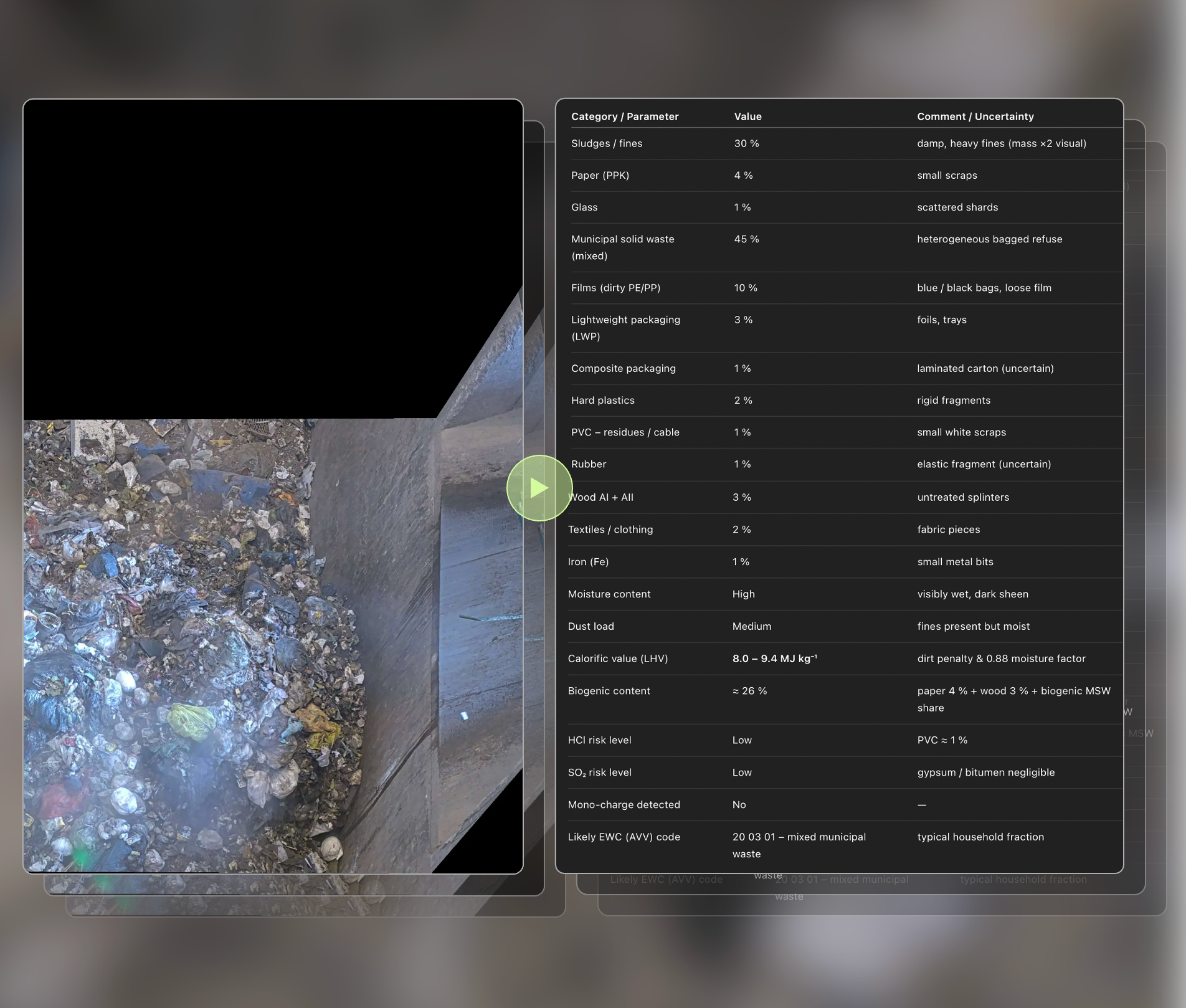
Composition analysis at the gate does not replace a recognised measurement method. It complements one. WS Scan captures every delivery with high-resolution cameras as it is tipped and estimates its composition and key figures such as calorific value and biogenic share, linked to the vehicle through licence plate recognition. Over weeks and months that builds a delivery-level record: which suppliers bring plastic-rich loads, how composition shifts by season, and how a monthly carbon-14 result relates to what actually came through the gate.
For a plant preparing for a carbon price, that is the context around the official number: the reference method says what the share was, the delivery record says why. The record also feeds the digital waste control report and the calorific value analysis the plant already uses for operations.
FAQ
What share of waste incineration CO2 is fossil? Typically around half. Empa reports an average fossil carbon share of 48 ± 4% in Switzerland; a 2026 study found biogenic CO2 shares of 55 to 64% at three Austrian plants. Individual plants vary with their waste.
Which method is most accurate? Carbon-14 in the flue gas measures the biogenic share of what was burned directly and is often treated as the reference. The balance method agrees closely on the share and can run continuously from operating data. For absolute tonnes of fossil CO2, both depend on other measurements, especially flue gas volume.
Is the balance method accepted in Germany? According to TU Wien, the balance method under ISO 18466:2016 and adapted forms of it are accepted for CO2 monitoring of waste-to-energy plants under the BEHG. Confirm the details for your plant with the DEHSt.
Can image-based composition analysis replace carbon-14 measurement? No. It provides per-delivery estimates that explain and allocate the fossil share, not a recognised measurement for reporting.
How often is carbon-14 sampled? ISO 13833 covers integrated sampling periods from one hour up to one month. The frequency a plant must use is set by its monitoring plan and scheme.