Since 1 January 2024, thermal waste treatment in Germany has been part of national fuel emissions trading under the Brennstoffemissionshandelsgesetz (BEHG), Germany's national fuel emissions trading act (EEW Energy from Waste). For 2026 a price corridor of 55 to 65 euro per emissions certificate applies, which means per tonne of CO2. Only the CO2 from the fossil components of the waste is priced, not the biogenic CO2 from paper, wood or food waste. That makes the biogenic share the single most important lever on an incineration plant's CO2 costs.
In autumn 2026 a lot is moving: an administrative court has upheld the BEHG obligation for incineration plants, the Bundestag has passed a BEHG amendment and is calling for relief, and at EU level there is a proposal on the table for entry into the EU Emissions Trading System from 2031. This article summarises the position at the end of October 2026. It is general information, not legal advice; operators should clarify their plant's specific situation with the Deutsche Emissionshandelsstelle (DEHSt), the German Emissions Trading Authority.
What applies in 2026
Who pays: Plant operators are required to determine their emissions and surrender the corresponding certificates. The costs can be passed on to customers through gate fees; EEW says they can be "determined according to who caused them and passed on transparently to customers" (EEW, translated from German).
How it is calculated: Standard emission factors are set for common waste codes, and the ordinance also sets default values for the biogenic share of certain waste codes (EEW). For residual waste the default biomass share is 53.5% (EUWID Recycling). In other words, 46.5% of the CO2 from residual waste is priced.
Is it lawful: Yes, at first instance. In judgments of 21 May 2026 the Verwaltungsgericht Berlin (Berlin Administrative Court) dismissed actions brought by two operators, one of a hazardous waste incinerator and one of a household waste incinerator. The court held that exclusion from the European emissions trading system does not rule out setting a national CO2 price, and that the charge is not a tax but a non-tax levy. An appeal to the Higher Administrative Court of Berlin-Brandenburg has been admitted (beck-aktuell).
What could change
The 2026 BEHG amendment: In October 2026 the Bundestag passed a BEHG amendment. The price corridor of 55 to 65 euro per tonne of CO2 is to continue in 2027. In an accompanying resolution the Bundestag calls for the default biomass share for residual waste to be raised without delay from 53.5% to 57%, and asks the federal government to examine whether incineration plants that will not be covered by the European emissions trading system in future can be exempted from the BEHG (EUWID Recycling). A resolution is a request to the government, not a change in the law. Whether and when the higher default value will apply is open.
Bundesrat: The committees of the Bundesrat, the upper house representing the federal states, have recommended taking household waste and hazardous waste incinerators out of the BEHG altogether; the plants would then no longer be subject to national emissions trading (Bundesrat, Drucksache 462/1/26). This is a recommendation in the legislative process, not adopted law.
EU emissions trading from 2031: On 17 July 2026 the European Commission proposed bringing installations that incinerate non-hazardous waste above 3 tonnes per hour into the EU ETS in stages from 2031: 25% of verified emissions for 2031, rising to 100% from 2034, with a possible national exemption until 2035 (letsrecycle.com). How that will interact with the BEHG has not yet been decided. More detail in our article on the EU ETS phase-in from 2031.
For planning purposes this means: in 2026, and probably in 2027, the BEHG price corridor applies with the existing default values. Everything beyond that depends on decisions that are still outstanding.
Why the biogenic share decides the cost
In simplified terms, a plant's CO2 costs are the product of waste volume, emission factor, fossil share and certificate price. An operator has little influence over volume and price. The fossil share, by contrast, is a property of the waste delivered, and it is precisely this share that is currently represented by default values.
The change the Bundestag is calling for shows how much this matters. If the default biomass share for residual waste rises from 53.5% to 57%, the priced fossil share falls from 46.5% to 43%. That is around 7.5% lower CO2 costs on residual waste, without anything about the waste itself having changed. Each percentage point of biogenic share moves the cost of residual waste by just over 2%.
At the same time, a single default value is a rough assumption. Studies by TU Wien at Austrian plants found biogenic shares of calorific value with annual averages ranging from about 36% to 61% (TU Wien). A plant's waste can therefore differ significantly from the default value, in either direction, and it varies with the season, the catchment area and the supplier.
There are established methods for determining the biogenic share: manual sorting analysis, the selective dissolution method, the radiocarbon (C14) method and the balance method (TU Wien); for solid recovered fuels, CEN/TS 15747 describes C14 determination (iTeh, CEN/TS 15747). According to TU Wien, the balance method under ISO 18466:2016 and adapted forms of it are accepted for CO2 monitoring of waste-to-energy plants under the BEHG, using only routinely measured operating data (TU Wien, BIOMA). We compare the methods in fossil vs biogenic CO2: how to measure it. How a plant-specific determination is applied in a given case is governed by the Emissionsberichterstattungsverordnung 2030 (EBeV 2030), the emissions reporting ordinance, and by DEHSt requirements. Operators should clarify this with DEHSt before investing.
What operators can do now
Allocate costs to those who cause them. BEHG costs are passed on through gate fees. An operator who knows which supplier delivers which waste can justify surcharges instead of spreading them across everyone. That requires data per delivery, not just annual figures.
Know your own biogenic share. Even if billing runs on default values, a plant that knows its actual biogenic share and how it fluctuates knows whether a plant-specific determination would pay off and how a change to the default value would affect it.
Prepare for 2031. If the EU ETS arrives as proposed, plants will need a monitoring plan and robust data before the first reporting year. A data series that starts today will by then cover several years.
Follow the process. The resolution on the default value, the review of a possible exemption, the Bundesrat recommendation and the appeal against the Berlin judgment could all move costs in either direction.
Where Wasteer comes in
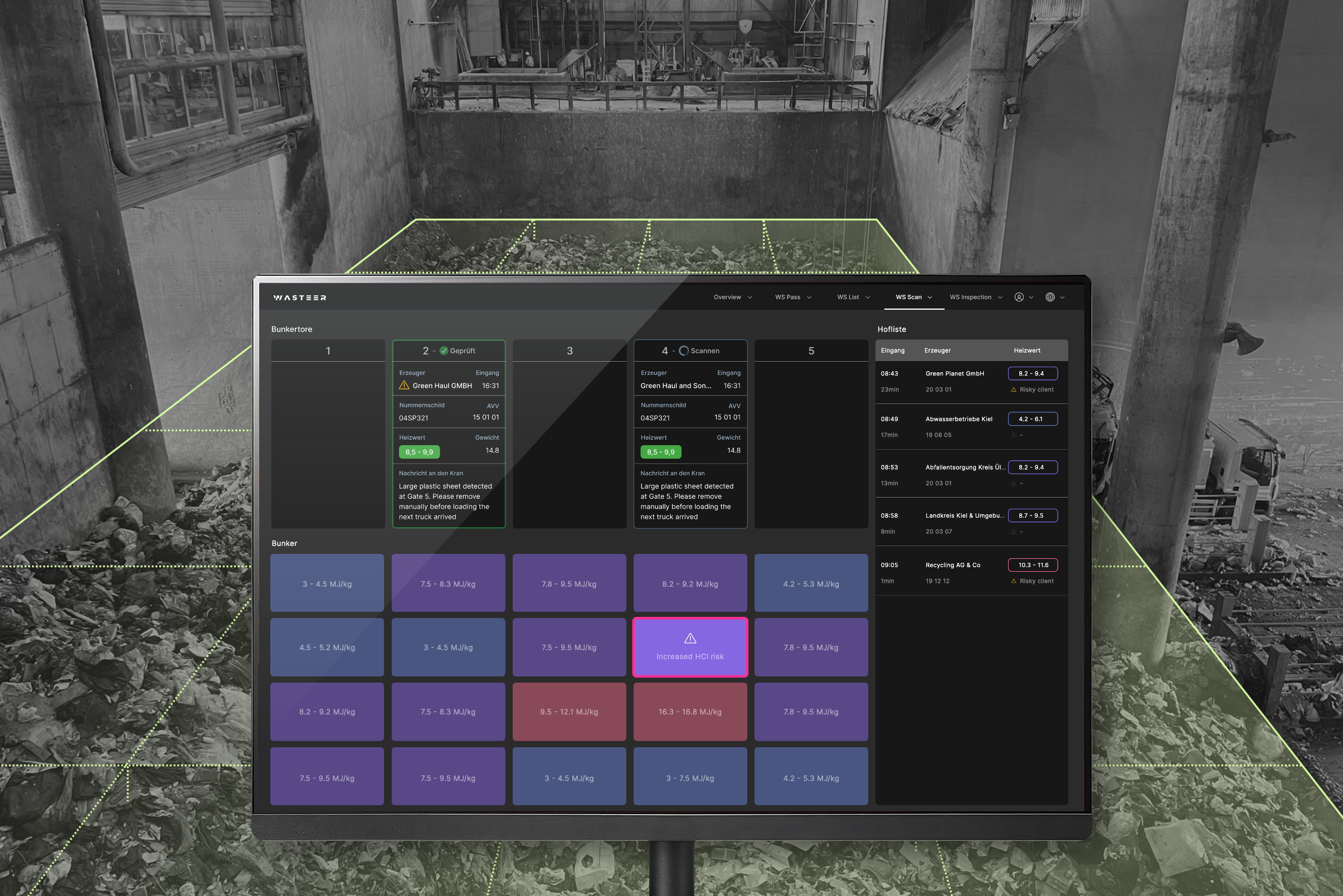
Wasteer analyses every delivery as it is tipped. WS Scan captures the delivered waste with high-resolution cameras, detects contaminants and calculates parameters such as calorific value and biogenic share, per delivery and traceable to supplier and licence plate (WS Plate). This does not replace a recognised determination method or verification by DEHSt. What it does provide is the ongoing data basis that shows where a plant's own waste sits relative to the default value, which deliveries drive the fossil share and how that changes over the year. How this data relates to calorific value is covered in our article on calorific value analysis in waste incineration.
FAQ
Since when has the BEHG applied to waste incineration plants? Since 1 January 2024. The CO2 from the fossil components of the waste is priced.
What is the CO2 price in 2026? For 2026 a price corridor of 55 to 65 euro per tonne of CO2 applies. Under the BEHG amendment passed in October 2026, this corridor is to apply in 2027 as well.
What biogenic share is assumed for residual waste? The default value is 53.5%. The Bundestag has called on the federal government to raise it to 57%; this has not yet been implemented.
Will waste incineration plants be taken out of the BEHG? That is open. The Bundesrat committee has recommended it, and the Bundestag has asked the government to examine an exemption. Nothing has been decided.
Has a court ruled on the BEHG obligation? Yes. In judgments of 21 May 2026 the Berlin Administrative Court confirmed that waste incineration plants are subject to the BEHG. An appeal has been admitted, so the judgments are not yet final.
Does Wasteer replace a C14 measurement or a sorting analysis? No. Wasteer provides ongoing per-delivery estimates from image analysis. For reporting purposes, the methods and requirements of the EBeV and DEHSt apply.