A waste control report (Abfallkontrollbericht) is the record a plant produces to show what arrived at the gate, what it was, and what happened to it. Every facility handling third-party waste has to keep one, in some form, for every delivery. The paperwork burden is old news to any technical director; the audit risk that comes with doing it by hand is the part that keeps surfacing at the wrong moment - during a permit review, an unannounced inspection, or a dispute with a carrier over what was actually delivered. A digital waste control report closes that gap by tying the record to the delivery event itself, rather than to a form filled in afterward.
This article covers what the report has to contain, why the manual version breaks under real operating conditions, and how delivery data becomes a signed, retrievable digital waste control report without a second data-entry step.
What a waste control report has to contain, and why manual versions fail audits
At minimum, a defensible waste control report ties each delivery to: the carrier and vehicle, the contracted waste stream and any deviation from it, the weighed quantity, a description of the material actually received, and - where the plant tracks it - an estimated calorific value and any contaminants or hazards observed. The report has to be complete for every delivery, not a sample, and it has to be retrievable on demand, not reconstructed after the fact.
Manual versions fail for structural reasons, not because staff are careless. A gatehouse operator or shift supervisor fills in a form under time pressure, often from memory or from a weighbridge ticket that doesn't capture composition at all. Contaminant observations get written down if someone happens to notice and has time to log it. Calorific value, if estimated at all, is usually a single figure for the whole delivery rather than a documented assessment. None of this is dishonest. It's what happens when a compliance record depends on a person doing a second job on top of running the gate. The gap surfaces later: during an audit, when a regulator asks for the report tied to a specific delivery three months back and the description on file reads "mixed household waste, no issues" with nothing behind it.
Legal basis: Nachweisverordnung and 17. BImSchV documentation duties
In Germany, the documentation duties a waste control report serves come from two directions. The Nachweisverordnung (NachwV) governs the electronic tracking of waste movements - the eANV system - and requires operators to be able to demonstrate what waste moved where, under whose responsibility, and when. Separately, the 17. BImSchV (Verordnung über die Verbrennung und die Mitverbrennung von Abfällen), most recently amended in February 2024, sets operating and monitoring conditions specific to waste incineration and co-incineration plants, including requirements around waste acceptance and input control at the point of delivery.
These are not the same regulation and shouldn't be treated as interchangeable. NachwV concerns the traceability chain across the waste's movement; 17. BImSchV concerns how the incineration plant itself controls and documents what it accepts at the gate. A waste control report sits at the intersection: it is one of the records a plant produces to show it meets its input-control and documentation duties under both.
Two points worth being precise about. First, paragraph-level requirements vary by permit and by state authority (Land), so a general article can describe the duty but shouldn't cite a section number as if it applies uniformly to every plant - check your own permit conditions and consult your compliance officer or legal counsel for the specifics that apply to your facility. Second, and this matters for anything sold as a solution to this problem: software that captures and structures delivery data supports these duties by producing the record and the audit trail they require. It does not, by itself, discharge the legal obligation. Compliance remains the plant's responsibility; the report is evidence of how that responsibility was met.
How Wasteer automates the digital waste control report
Wasteer's approach is to capture what a waste control report requires at the point where the data already exists - the delivery itself - rather than asking someone to re-enter it afterward.
Data captured per delivery
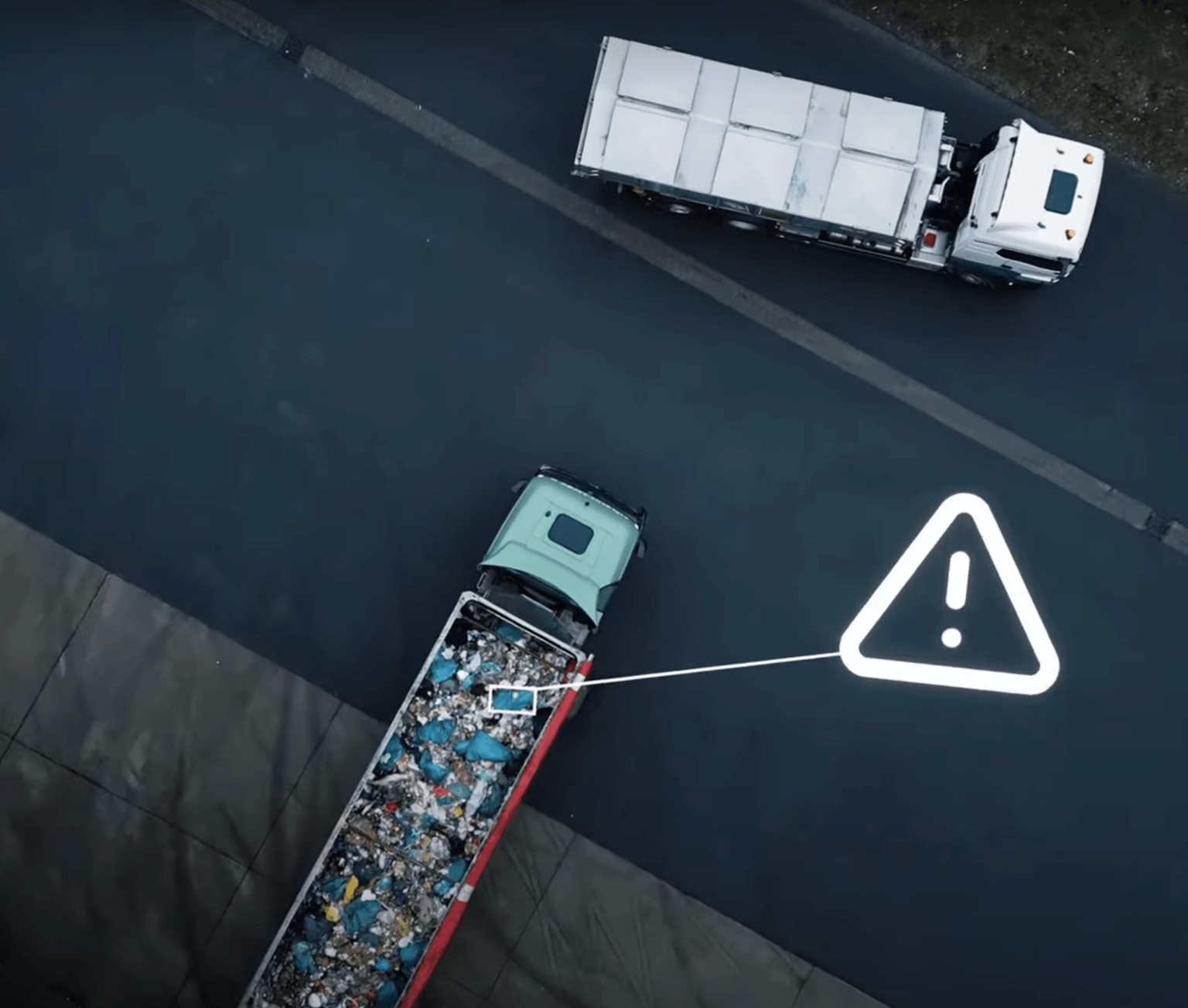
For every delivery, the system records the carrier and vehicle (via plate recognition at the gate where installed), the weighed quantity from the scale, an AI-based assessment of waste composition, an estimated calorific value, and any contaminant flags raised by the intake cameras - batteries, gas cylinders, oversized items, or other anomalies. Each of these fields maps directly onto what a manual waste control report is expected to contain; the difference is that they are captured automatically, at the moment of delivery, rather than typed in afterward from memory or from a weighbridge slip.
From delivery event to signed report, with no manual re-entry
Because the data originates at the delivery event rather than in a form filled out later, generating the report is a matter of structuring and presenting data that already exists, not collecting it fresh. The system assembles the per-delivery record - carrier, weight, waste description, calorific value estimate, contaminant flags - into the report format the plant needs, ready for sign-off. There is no second transcription step where a person copies numbers from one system into another, which is exactly the step where manual processes accumulate errors and gaps.
Audit trail and retention
Every field in the report is backed by the underlying evidence: timestamped images from the intake cameras, the weighbridge record, and the model output that produced the composition and calorific value estimate. That evidence is retained alongside the report, so when an auditor or regulator asks about a specific delivery, the plant can produce not just the report line but the record it was built from. This is the part manual processes structurally cannot match: a handwritten note carries no evidence trail behind it, and a spreadsheet entry is only as good as whoever typed it.
Across the roughly 28 facilities in 7 countries where Wasteer currently runs, this is already how intake data is captured: the fields a manual Abfallkontrollbericht requires (carrier, weight, waste type, calorific value estimate, contaminant flags) are recorded automatically at the point of delivery, not reconstructed afterward.
Where this connects to EU ETS and UK ETS MRV reporting
The same per-delivery data that feeds the waste control report has a second life in emissions reporting. Under both the EU ETS extension to waste incineration and the UK ETS, operators need defensible, delivery-level evidence of waste composition to support fossil-versus-biogenic attribution. The same delivery data feeds MRV-grade emissions reporting once it exists in this structured form, and the 2028 EU ETS picture adds further weight to getting intake documentation right now rather than retrofitting it under deadline pressure. This is a bridge, not the full case for either scheme; the depth on MRV and ETS mechanics lives in those articles.
FAQ
Does Wasteer's waste control report replace the legal obligation under Nachweisverordnung or 17. BImSchV? No. It produces the record and the audit trail these duties require at the point of delivery. Meeting the underlying legal obligation remains the plant's responsibility, and specific requirements should be confirmed against your permit conditions and current guidance.
Can the report be customized to match our existing template or authority requirements? The underlying data - carrier, weight, waste description, calorific value estimate, contaminant flags - is captured in a structured format that can be presented in the layout a plant's permit or internal process requires. Confirm the specific template mapping during implementation.
What happens if a camera misses something, or a delivery has no camera coverage? The system flags gaps in coverage rather than silently filling them in. Where a delivery lacks full data - camera outage, occlusion, or a manual gate override - that gap should be visible in the report rather than papered over, so the plant can add a manual note where needed.
Does this work with our existing weighbridge and gate systems? Integration depends on what's already in place. Wasteer is designed to sit alongside existing scale and gate infrastructure rather than replace it, with modules such as license plate capture attaching to hardware many plants already have. Confirm the specific integration path during a technical scoping call.
If you want to see how this fits into the wider intake and compliance stack, our full range of solutions covers it.